

You’ve built something real. Your company has steady revenue, a capable team, and a reputation earned over years of hard work. You might feel like you’re ready to sell your business, whether that means retiring, chasing a new venture, or taking some chips off the table.
Timing matters more than most owners realize. Many owners are in a stronger position when they consider a transition while the business is performing well and they feel good about its direction. Waiting until challenges begin to limit your options can make the process harder.
Buyers evaluating government contracting (GovCon) and software companies weigh what makes a company attractive for mergers and acquisitions (M&A). Your M&A advisor can help you see the business the way they do, and recognizing the signs that it may be time to consider a transition is the first step.
What Buyers Look for in an M&A Target
Buyers consider what you’ve already built, but they focus heavily on what your company can continue earning in the future, especially if the business can perform without your daily involvement. That distinction shapes financial attractiveness more than any single balance-sheet number.
Financial Health
When buyers look at the quality of earnings, they want to know whether your company’s financials are clean, consistent, and believable under close examination. In many lower-middle-market deals, buyers ask to review three or more years of financial statements, and buyers expect earnings before interest, taxes, depreciation, and amortization (EBITDA) that holds up to scrutiny. That means well-documented add-backs and no last-minute surprises.
Quality of Earnings
Buyers are underwriting future cash flow, not past performance, but a clean financial history is what makes that future believable. In the lower-middle market, companies with above-average financials may command stronger buyer interest and more favorable valuation discussions.
Recurring Revenue
Recurring revenue can be an important driver of a company’s attractiveness to M&A buyers because it may reduce the risk a buyer assumes, and your M&A advisor can help you evaluate how buyers are likely to view that revenue.
Revenue Predictability
Customer concentration matters too, and when a single customer accounts for much of your revenue, buyers can flag it and price that risk into their offer. Recurring revenue can support stronger valuation discussions than purely project-based revenue, though the impact depends on the industry, customer retention, contract terms, margins, and buyer priorities. This plays out differently by industry, with GovCon relying on contract vehicles and backlog and software leaning on annual recurring revenue, both covered below.
Operational Independence
Operational independence is one of the operational and risk factors buyers weigh most heavily in diligence.
Management depth is one of the first signals buyers look for. They want to see a second layer of leadership that can answer questions and keep the business moving without you in the room. They also want documented processes that capture institutional knowledge rather than tribal know-how. Just as important, they want customer relationships to belong to the business, not only to you personally.
The valuation consequence is concrete — a business that can’t run without its founder can sell at an EBITDA discount compared to management-run peers. This kind of dependence can become a major diligence concern, alongside customer concentration, margin volatility, and other operational risks.
Your M&A advisor can help identify where dependence shows up through an M&A readiness assessment, giving you time to systematize your operations before you begin the transition process.
Industry-Specific Value Drivers for GovCon and Software Buyers
GovCon and software companies carry unique assets and risks that shape strategic fit. An M&A advisor can help translate those industry-specific details into buyer-facing positioning.
Which Key Assets GovCon Buyers Scrutinize
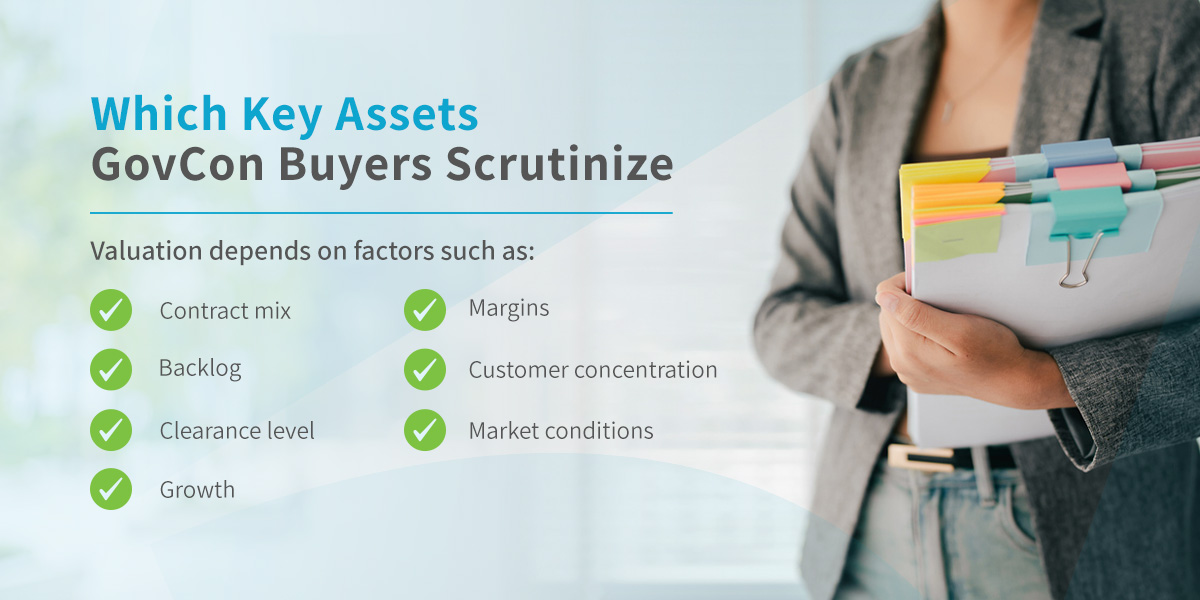
Federal agencies are awarding record levels of work to small businesses — nearly 28% of prime contract dollars went to small businesses in fiscal year 2025, totaling $179 billion and exceeding the 23% statutory goal. Still, GovCon buyers evaluate assets that don’t show up on a balance sheet, and what GovCon buyers evaluate can make a real difference.
A buyer weighing funded backlog and pipeline visibility is really asking how much future revenue they can count on. Prime positions on major Indefinite Delivery/Indefinite Quantity and Government-Wide Acquisition Contract vehicles, such as OASIS+, CIO-SP4, and GSA MAS, can provide pipeline visibility because they require significant time and effort to win. Set-aside certifications and size status carry their own risks, as changes in ownership can affect eligibility.
Security clearances add value differently — facility clearances don’t transfer automatically, but a cleared workforce does. Some private lower-middle-market GovCon companies may trade at higher EBITDA multiples, but valuation depends on factors such as contract mix, backlog, clearance level, growth, margins, customer concentration, and market conditions.
What Software and SaaS Buyers Evaluate
Software and SaaS buyers look for a different kind of confidence. They focus on metrics, scalability, and the defensibility of the software offering’s market position. Annual recurring revenue (ARR), net revenue retention, gross margins, churn rate, and how quickly customer acquisition costs pay for themselves all factor into the multiple.
If the technology is sticky, hard to replace, and supported by strong net retention, the company may be positioned for a higher multiple than one built primarily on project-based revenue.
One newer factor buyers are watching is whether a product solves a problem AI tools are starting to handle on their own, a real valuation risk documented in PwC’s AI valuation research on software M&A.
How to Maximize Your Company's Fair Market Value
Getting your business ready for sale comes down to preparation well before you sign anything, and it breaks down into five key steps.
- Start early: Most advisors recommend beginning preparation 18 to 24 months before going to market, based on research on pre-sale preparation timelines, since the work you do now is what buyers can see later.
- Get a baseline valuation: Your M&A advisor can help you understand the current fair market value and identify areas that may need attention before you begin the transition process.
- Reduce owner dependence: Your M&A advisor can help you identify where the business still depends too heavily on you, giving you time to strengthen management depth, document key processes, and shift customer relationships toward the company.
- Strengthen recurring revenue: Look at whether project-based clients could move to retainer or contract arrangements.
- Clean up your financials: Your M&A advisor can help you understand what buyers may expect to see, including clear, consistent financials and defensible EBITDA.
That momentum circles back to the owner’s conundrum — the best moment to act is while the business is doing well, not once things slip. The stages of the M&A process can help you plan your next move alongside your M&A advisor.
Start the Conversation With sbLiftOff
If you’re thinking about a transition in the next few years, now is the time to understand where you stand. sbLiftOff works with GovCon and software companies, and our team understands the unique assets and risks buyers evaluate in your industries.
We handle the work on your behalf, from assessing readiness to positioning your company and connecting you with the right buyers. With a white-glove, relationship-driven approach and extensive transition experience, sbLiftOff can help you see your business the way buyers do.
Reach out to our team to start a conversation about our sell-side M&A advisory services.